Showing posts with label volkswagen. Show all posts
Showing posts with label volkswagen. Show all posts
Monday, March 17, 2014
Volkswagen Golf Car Model
 |
| 2013 Volkswagen Golf Car Model |
 |
| 2013 Volkswagen Golf Car Model |
 |
| 2013 Volkswagen Golf Car Model |
 |
| 2013 Volkswagen Golf Car Model |
 |
| 2013 Volkswagen Golf Car Model |
 |
| 2013 Volkswagen Golf Car Model |
 |
| 2013 Volkswagen Golf Car Model |
 |
| 2013 Volkswagen Golf Car Model |
The new VW Golf, but also a team that features innovative standard security systems is optional between the systems of many previously only available on vehicles in a class above. Standard on all new Golf models is a multi-crash brake system. This automatically brakes the vehicle after a collision, to reduce the kinetic energy significantly and, thus minimizing the chance of a second domain. In germany, the research shows that around a quarter of the accident involving personal injury, there are multi-collision events. Also standard is PreCrash system made its debut on the Touareg. If it detects the possibility of an accident, this pre-tensions safety belts and closes the windows and sunroof, behind only a small space, to provide the best protection possible from the airbag.
For the first time, Volkswagen Golf is also available with the driver profile selection, which allows the driver to the four modes - the Environment, Sport, Normal and Individual; a DSG gearbox with the fifth option - Comfort - are also available. Each of these modes change the gas mapping and engine management (other parameters) to the selected style, so the Eco mode, for example, engine management, air and auxiliary systems, controlled to achieve maximum fuel consumption.
Powering the VW Golf VII a new range of petrol and diesel engines, all of which combine a Stop/Start and battery regeneration facilities. At Launch, petrol engines 1.2-liter TSI 85 PS unit returning to 4.9 litres/100 km (approximately 57.6 mpg, 113 g/km), and the 1.4-litre TSI 140 PS unit with the Active Cylinder Technology, which can disable the two-cylinder, manages up to 4.8 l/100 km (58.9 mpg and 112 g/km). The launch of the diesel engines of 1.6-litre unit with 105 PS, which returns the 3.8 l/100 km (74.3 mpg and 99 g/km and a 2.0-liter 150 PS unit which turns 4.1 l/100 km (68.9 mpg and 106 g/km).

Sunday, January 19, 2014
2011 Volkswagen CC Price of 40 000
 The 2011 Volkswagen CC is the latest version of 2011 Volkswagen. 2011 Volkswagen CC is available at a price not more than $40,000 and available in 6 trims, ranging from the Sport to the VR6 4Motion Executive.
  The new 2011 Volkswagen CC is a four-door-coupe version of the company’s famed Passat, and it offers great looks at an affordable price. Although 2011 Volkswagen CC is all well and good, it left us wondering; would the 2011 Volkswagen CC be more than merely a Passat wrapped in attractive sheet-metal?
 Upon introduction, the 2011 Volkswagen CC Sport is prepared with a standard 2.0-liter, I4, 200-horsepower, turbo engine that achieves 21-mpg in the city and 31-mpg on the highway. A 2011 Volkswagen CC has 6-speed manual transmission with overdrive is standard, and a 6-speed automatic transmission with overdrive is optional. The 2011 Volkswagen CC VR6 4Motion Executive is equipped with a standard 3.6-liter, V6, 280-horsepower engine that achieves 17-mpg in the city and 25-mpg on the highway. A 2011 Volkswagen CC gets 6-speed automatic transmission with overdrive is standard.
 Saturday, November 30, 2013
Volkswagen CC Price 30 000


The 2013 Volkswagen CC will most certainly become a favorite among those who loves to drive in style in a coupé, but want space for more people inside it. According to the details provided by Volkswagen, the 2013 Volkswagen CC will be powered by 2.0-liter turbocharged and direct-injected four-cylinder engine. It can generate up to 200 horsepower.
 Another version will have a 3.6 liter V-6 engine which can produce up to 280 horsepower. The 2013 Volkswagen CC has 2.0-liter model will be equipped with a new XDS cross-differential (limited-slip) system. This 2013 Volkswagen CC system can electronically monitor inputs from different wheel sensors and transfer extra torque to the front wheels. The V-6 engine will be aided by six-speed automatic transmission system with Tiptronic shifting. The new 2013 Volkswagen CC is spacious and luxurious from inside. A three-seat rear bench has been added to make the coupe comfortable for five passengers. The 2013 Volkswagen CC seats have been designed ergonomically for long trips and equipped with integrated massage function.
 Monday, November 18, 2013
Volkswagen Cross Coupe TDI Concept 2012


- Volkswagen Cross Coupe TDI Concept, 2012
Research - regardless of the area of research - always aims to identify solutions that point the way to the future. In December 2011, it was the VW Cross Coupé - a concept vehicle from Volkswagen - which with a fuel consumption value of just 2.7 l/100 km (equivalent to 62 g/km CO2) illustrated a technical approach to implementing an SUV that can be extremely fuel-efficient despite its high performance and all-wheel drive system. This plug-in hybrid concept was driven by two electric motors and a turbocharged petrol direct-injection engine (TSI). Now, Volkswagen has conceptualised an even more fuel-efficient Cross Coupé. It is powered by an alliance of a turbodiesel direct-injection engine (TDI) and two electric motors. Its combined fuel consumption in the New European Driving Cycle (NEDC) is a sensationally low of 1.8 l/100 km. This is equivalent to CO2 emissions of just 46 g/km. Noteworthy here is the fact that the Cross Coupé is a powerful SUV with a top speed of 220 km/h, 225 kW / 306 PS of power (system power) and a kerb weight of 1,858 kg. Volkswagen is presenting the concept with a TDI plug-in hybrid in a world premiere at the Geneva International Motor Show (08 to 18 March 2012).
Efficiency and driving fun meld together
High-tech network. Technically, the SUV is based on the new Modular Transverse Matrix (MQB) from Volkswagen AG.
Within the MQB, there are certain design parameters that are standardised across model series and brands - such as the distance between the accelerator pedal and the front wheel axis and the mounting position for all engines. There are also variable parameters that make it possible to optimally and individually develop a wide variety of models. They include such parameters as the wheelbase, track widths and wheel sizes, for example.
In the new Volkswagen Cross Coupé, MQB elements for a future generation of SUVs - in this case, the MQB front and rear suspensions, 140 kW / 190 PS TDI of the new EA288 engine series and a 6-speed DSG. They were merged with electrical components that are also "made by Volkswagen", and they include the lithium-ion battery in the centre tunnel, front E-motor with 40 kW and rear E-motor with 85 kW.
Breadth of variations. The Cross Coupé also impressively demonstrates the large breadth of variations that can be implemented based on the MQB. It should be noted that the modular systems used in the concept car could theoretically have been used, just as easily, to produce a full hybrid (without external interface) or a vehicle with only an internal combustion engine or only an electric drive instead of the plug-in hybrid (battery with external interface for charging) that was actually implemented.
Efficiency and dynamic performance. Efficient drive technologies can offer extreme levels of dynamic performance. The new Cross Coupé demonstrates this par excellence. Its combination of cutting-edge fuel efficiency and exceptional dynamic performance demonstrate that an all-round vehicle of a sporty kind has been created here like never before. The Volkswagen Cross Coupé being shown in Geneva accelerates to 100 km/h in just 6.5 seconds, and its TDI develops a torque of up to 400 Nm from very low revs - from approx. 1,600 rpm. Practically at the press of a button, the two E-motors deliver 180 Nm of torque in front and 270 Nm at the rear. During boosting - which involves full use of both motors and the engine - the drive system supplies a maximum system torque of 700 Nm. This performance positions the concept car in the field of todays high-performance sports cars, yet the vehicle consumes less fuel than any other small car!
Intelligent networking of drive systems
Zero emissions thanks to electric motors. In pure electric mode - in this case its speed is limited to 120 km/h -, the concept car can cover up to 45 km. This is sufficient driving range for most of the worlds commuters to drive to work with zero emissions. In pure E-mode, the driver can choose whether the focus should be on optimising electric driving range or dynamic performance. This is implemented by the combination of E-mode and CITY mode and the combination of E-mode and SPORT mode. In the electric driving range maximising E-mode (CITY), only the E-motor on the rear axle powers the car. In the dynamic E-mode (SPORT), the electric drive system powers both the rear and front wheels. In pure electric driving, the turbodiesel is decoupled from the drivetrain by disengaging the clutch, and it is shut off. The clutch on the gearbox side remains closed, and the 6-speed DSG is engaged. The E mode is activated by pressing what is knowna s the EV mode button (EV: electric vehicle) next to the gear shift lever. The Cross Coupé then drives like a purely electric vehicle. Even during fast driving, the internal combustion engine is not engaged, provided that the battery is sufficiently charged. As soon as the power of the TDI is needed again, either because of the batterys charge state or other parameters, the engine engages without any jolt, and it is once again actively coupled to the drivetrain within fractions of a second.
Battery in the centre tunnel. In pure electric driving, the E-motors are supplied with energy from a lithium-ion battery that consists of eight modules. The battery has an energy capacity of 9.8 kWh and is located in the centre tunnel of the Cross Coupé. Power electronics operating at a voltage of approx. 370 Volt, which is integrated in the front engine compartment, manages the flow of high-voltage energy to and from the battery and the electric motors. Meanwhile, the 12 Volt electrical system is supplied with power via a DC/DC converter. The electric drive system does not impose any space limitations on the interior. The battery can be charged either from external power sources (230 Volt connection) or while driving.
Charging also at push of a button. The driver can intentionally switch to CHARGE mode (by pressing another button next to the gear shift lever) to charge the battery via the TDI engine while driving. This mode might make sense, for example, if the driver wishes to drive in certain designated environmental zones that might be toll-free for electric vehicles operating with zero emissions. The momentary electric driving range and total range of the Volkswagen Cross Coupé are continually displayed in the instruments. An engine controller regulates the overall energy and drive management system under consideration of the specific load demanded by the driver. The driver can choose from a total of five driving modes: CITY (an eco mode with minimal fuel consumption), SPORT (high dynamic performance), OFFROAD (continuous all-wheel drive), E-mode (pure electric driving) as EV-CITY or EV-SPORT, or CHARGE (via the TDI). In parallel, the Cross Coupé utilises different operating states, in which the motors/engine and drive axles are coupled or decoupled as a function of driving needs:
Zero emissions by sailing. As soon as the driver lifts his or her foot from the accelerator, both electric motors and the engine are shut off and decoupled from the drivetrain - provided that the battery is sufficiently charged. This is referred to as sailing. Zero emissions are generated in this case as well.
Zero emissions in battery regeneration mode. If the driver takes his or her foot off the accelerator pedal or brakes, and the battery is not sufficiently charged, the two electric motors are operated as generators to feed energy recovered from braking into the lithium-ion battery. The TDI is also shut off and decoupled in this operating state.
Boosting. When driving should be especially sporty in nature, the E-motors form an alliance with the TDI. In the professional jargon of the hybrid world this joining of forces is known as Boosting. The Cross Coupé is driven by all four wheels in this mode.
Offroad with electric propshaft. As soon as the driver chooses to activate OFFROAD mode, all four wheels are once again driven. However, in this mode the front electric motor, now supplied with energy by the TDI, is the sole source of electrical power for its counterpart at the rear axle. Since the energy for the rear electric drive is by wire and does not flow mechanically, this is referred to as an electric propshaft. Since the TDI powers the rear electric motor via the front electric motor in OFFROAD mode, the all-wheel drive system is fully functional, even if the lithium-ion battery is in a low charge state.
Driving with the TDI. If the TDI is powering the vehicle by itself, the Cross Coupé is a pure front-wheel drive vehicle. In driving states in which greater fuel efficiency is possible by load boosting, the E-motors act as generators to charge the battery. When all of the on-board energy reserves are utilised, the vehicles combined fuel consumption value is 1.8 l/100 km; the vehicles 55 litre fuel tank thus enables a theoretical driving range of 1,287 km.
The new TDI of the Cross Coupés
Engines of the MQB. As noted, the TDI of the Volkswagen Cross Coupé is an engine developed especially for use in the Modular Transverse Matrix (MQB). A key characteristic of the MQB is a uniform mounting position for all engines. Therefore, Volkswagen developed two new engine series - the EA288 series was created for the diesels, and the EA211 series for the new petrol engines. Within the MQB, these two engine series and relevant electric motors make it possible to implement any classic, alternative or hybrid drive system.
Range of turbodiesels. The new TDI engines of the MQB will be available in versions with 1.6 and 2.0 litre displacement and will span a power range from 66 kW / 90 PS to the 140 kW / 190 PS of the concept car in Geneva. The diesel engines are not only exceptionally low-emitting, fuel-efficient and torque-strong. They are also exceptionally refined and smooth running. Consider the 2.0 TDI of the Cross Coupé: two balancer shafts are used. They eliminate system-induced free inertial forces that naturally occur in a reciprocating engine. Meanwhile, the toothed belt drive for the oil and vacuum pump, which operates in the sump oil, and the engines encapsulated injection nozzles also have a positive effect on acoustic comfort.
SUV styling meets coupé dynamics
More streamlined than other SUVs. At a length of 4,357 mm, the Cross Coupé is longer than a Golf and shorter than a Tiguan. The vehicles width (1,868 mm) and height (1,523 mm) are positioned exactly between these two bestsellers as well. The concept vehicles wheelbase of 2,630 mm is clearly long relative to its overall length (52 mm longer than in the Golf, 26 mm more than the Tiguan). This makes the body overhangs short (855 mm in front, 860 mm at rear), and in the interplay of all dimensions the cars overall proportions are extremely attractive. The vehicles large track widths of 1,585 mm (front) and 1,613 mm (rear) emphasise its powerful appearance. More important to driving on unpaved trails are parameters such as the vehicles approach/departure angles and its ramp angle. The approach angle in front is a good 24.2 degrees, while the departure angle at the rear is 32.5 degrees - excellent for offroad driving. The ramp angle, which is important for driving over hilltops, is 15 degrees.
Precisely shaped coupé silhouette. Defining the look of the Cross Coupé are its very long bonnet, new front end styling, passenger compartment shifted significantly towards the rear, and very streamline line of windows compared to conventional SUVs. Overall, the designers also gave the vehicle muscular, athletic and yet very clean lines. In keeping with the powerful appearance of the Volkswagen Cross Coupé, it is equipped with 20-inch alloy wheels fitted with 265/45 tyres. Towards the rear, a large-volume coupé-like C-pillar is built over the wheel housings.
Impressive front end. The characteristic horizontal lines of the Volkswagen face forge a link between present and future on the Cross Coupé. Different than on todays models, the designers have physically merged the xenon dual headlights and chrome ribs of the radiator grille. Specifically, the headlights join to two overlapping chrome strips. Chrome wings ascending towards the outside emphasise the vehicles width and are part of a new type of lighting concept; the lower of the two chrome wings contains the daytime running light, while the upper wing houses the direction indicators. The LED fog lights are mounted in the bottom section of the bumper.
Rear of a SUV coupé. The rear is also typified by a streamlined line of side windows. Typical of a coupé is the rear window that is worked in at a low angle. At its top, the boot lid terminates in a spoiler, which visually extends the roof surface and technically optimises aerodynamics as a trailing edge. The rear lights have a narrow profile. Typical of an SUV, meanwhile, is the brawny rear bumper, in which dual tailpipes are integrated to the outer left and right.
Sporty interior with rugged qualities
The best of two worlds. The SUV and coupé worlds form an exciting alliance in the Cross Coupé. In the four-seat interior, this has resulted in all design details being much sportier than in conventional SUVs. Consider the instruments: they have the dynamically precise lines of a coupé, but they are positioned up high as in an SUV. The surfaces of the instruments are very sophisticated in their construction, but they are designed to be very rugged. This ruggedness is also reflected in user controls, handles and the general feel of interior elements. Take the centre console, for example: two aluminium dials make control of powertrain and climate functions quick and easy. Located between these two dials is the button for the electronic parking brake, and in front of it are the gear shift grip of the 6-speed DSG, also in aluminium. Integrated in front of this, in turn, is the start button for the drive system. To the right and left of the gear shift lever, there are sturdy yet elegant grab handles and, on the right side, the selection buttons for pure electric driving and active battery charging. Further up, there is a touchscreen display, on which onroad and offroad navigation and all relevant vehicle features up to and including the audio system are shown.
Programmable instruments. Arranged behind the three-spoke steering wheel is a user-programmable instrument cluster display. A control wheel to the left of the gear shift lever can be used to dynamically change the display contents between the modes SPORT, CITY and OFFROAD. The functionally different display mode contents are activated based on this selection - a gyrometer, compass and topographic map are shown in OFFROAD mode, for example. All three modes have unique layouts, and they also have different colour schemes. Centrally positioned between the two round instruments is another multifunction colour display for showing vehicle information, the telephone menu, audio information and other navigation data as well as a 3D offroad view.
Ergonomics for long trips. The Volkswagen Cross Coupé is equipped with four individual seats, each designed as a shell with a permanently integrated head restraint. These seats exhibit very balanced ergonomic properties. There is ample room for all four occupants - to their sides, in front of them and above them. The backrests of the rear seats and front passengers seat can be folded forward completely to load surfboards, paragliders or other bulky equipment in the Cross Coupé. Helpful here: the backrests have exterior plastic shells; folding them produces a durable cargo surface. The boot behind the rear seats has a volume of 380 litres (up to the height of the window sill). When the interior is filled to the backs of the front seats and all the way to the roofliner, cargo capacity increases to 1,230 litres - a lot of space for a car that only consumes 1.8 l/100 km!
Thursday, November 14, 2013
2014 Volkswagen Golf GTD
VW Golf model range extends from June 2013 to a sporty diesel, the 2014 Volkswagen Golf GTD.
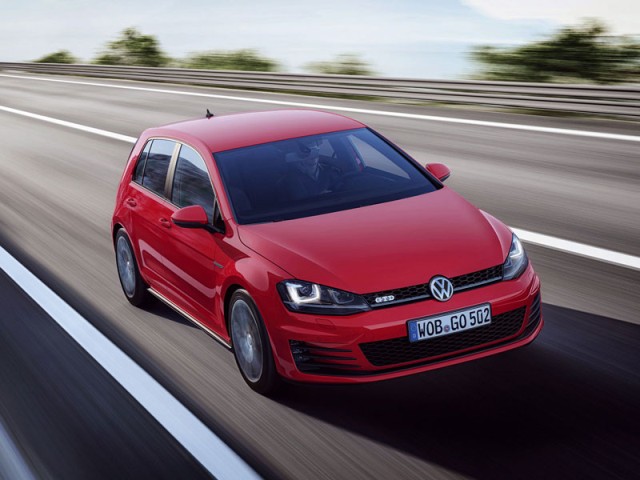
Since 1982, the acronym stands for New VW GTD for the sportiest diesel-powered version of the Golf, from June 2013, there will be the seventh-generation Golf as a sporty diesel. The most powerful diesel Golf ever is powered by a 2.0-liter TDI with an output of 184 hp (135 kW) and combines sporty acceleration data with a low fuel consumption.
After just 7.5 seconds the Golf VII GTD storms from the 100 km / h mark, the top speed is 230 km / h With a manual 6-speed manual transmission requires the strong golf just 4.2 liters per 100 kilometers, while CO2 emissions are thus at only 109 g / km.
If you opt for the optional 6-speed DSG gearbox to be fitted with 4.7 liters per 100 kilometers and CO2 emissions of 119 g expect / km. Its maximum torque of 380 Nm, the TDI delivers at 1,750 rev / min.

Visually, the VW Golf GTD is starting with tinted LED tail lights with LED-indicator lights, a chrome exhaust tailpipe, 17 "GTD-alloy wheels, a side sill and a large roof spoiler from the other diesel versions.
The chamber is equipped with a sport chassis Golf also shows very dynamic and offers sports seats with plaid "Clark", a black roof lining, a sport steering wheel, pedals and footrest in stainless steel and the GTD GTD instrument cluster and trim strips.
For colors, customers can choose between "Tornado Red", "Black" and "Pure White" select. In Germany, the Golf GTD will start from 29,350 euros. The delivery of the Volkswagen Golf GTD starts in June 2013.
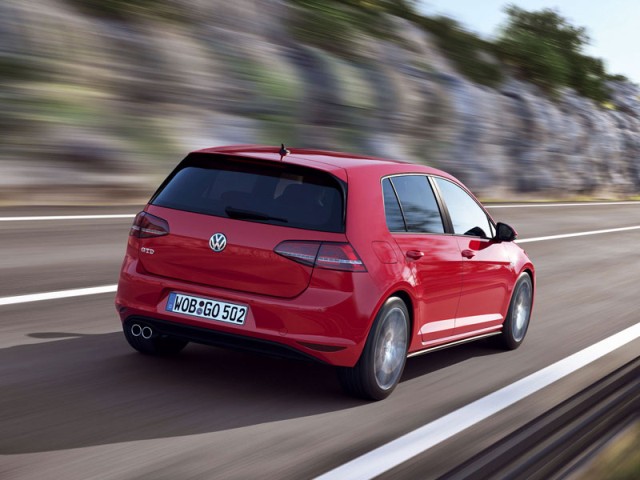
[ Read More.. ]
Since 1982, the acronym stands for New VW GTD for the sportiest diesel-powered version of the Golf, from June 2013, there will be the seventh-generation Golf as a sporty diesel. The most powerful diesel Golf ever is powered by a 2.0-liter TDI with an output of 184 hp (135 kW) and combines sporty acceleration data with a low fuel consumption.
After just 7.5 seconds the Golf VII GTD storms from the 100 km / h mark, the top speed is 230 km / h With a manual 6-speed manual transmission requires the strong golf just 4.2 liters per 100 kilometers, while CO2 emissions are thus at only 109 g / km.
If you opt for the optional 6-speed DSG gearbox to be fitted with 4.7 liters per 100 kilometers and CO2 emissions of 119 g expect / km. Its maximum torque of 380 Nm, the TDI delivers at 1,750 rev / min.
Visually, the VW Golf GTD is starting with tinted LED tail lights with LED-indicator lights, a chrome exhaust tailpipe, 17 "GTD-alloy wheels, a side sill and a large roof spoiler from the other diesel versions.
The chamber is equipped with a sport chassis Golf also shows very dynamic and offers sports seats with plaid "Clark", a black roof lining, a sport steering wheel, pedals and footrest in stainless steel and the GTD GTD instrument cluster and trim strips.
For colors, customers can choose between "Tornado Red", "Black" and "Pure White" select. In Germany, the Golf GTD will start from 29,350 euros. The delivery of the Volkswagen Golf GTD starts in June 2013.
Friday, November 8, 2013
Volkswagen Beetle Fender Edition


- Volkswagen Beetle Fender Edition, 2013
The VW Beetle is the first car in Europe that can be ordered with a sound system from guitar and amp makers Fender. In 2011, Volkswagen showcased a concept car at the IAA in Frankfurt that was designed to pay homage to the legendary American company. That was the exclusive Beetle Fender. With its powerful looks and no less powerful sound system (400 watts), the concept car thrilled visitors to the show so much that Volkswagen decided to make it into a production car. It is now made its world premiere at the 2012 AMI in Leipzig.
Black and chrome as an exclusive alliance
The Volkswagen Beetle Fender Edition is based on the already higher Design level specification. The new Beetle model can be ordered in two shades of black: Black Uni or Deep Black Pearl Effect. Black has been chosen so that the VW Beetle Fender Editions numerous chrome details are shown off to best effect. These include 18-inch Disc alloy wheels as standard, the wing mirrors, the strip below the side windows, the inserts in the side sills, the two Fender signs on the left and right front wings, the Beetle wording on the boot and, of course, the VW badge. The exterior standard specification also includes bi-xenon headlamps and LED daytime running lights.
Interior with dash pad in electric guitar style
The cars interior also has a very refined appearance. One very striking feature is the dash pad. Complete with chrome-plated Fender logo, it is finished in Sunburst style, the two-tone wood design of many Fender guitars. The instrument panel thus creates a visual link to the world of rock music. In keeping with this, Volkswagen ships each Beetle with three exclusive Fender guitar picks.
Further standard features of the black-trimmed interior include redesigned sports seats with specially created central sections in fabric and sides and headrests in a black leather look, contrast stitching on the leather steering wheel, gear knob and handbrake lever, colour trimmed floor mats, cruise control, air conditioning and, of course, the Fender sound system complete with USB interface (media in). The Fender system is controlled as standard via the panel for the RCD 510 audio system (featuring touchscreen, integrated CD changer for six CDs, double tuner and SD card slot).
Fender sound system inclusive of ambient lighting
Automatically included with the sound system is adjustable interior ambient lighting in three colours (white, red and blue). As well as indirect lighting strips below the front side windows, this includes an illuminated ring around each of the speakers in the doors. The sound system includes two high-end tweeters installed in each mirror triangle and rear side panel, while in the front doors are the woofers with double voice coils. Assigned to these are woofers in the rear side panels, each with a single voice coil. Additionally integrated into the system is a subwoofer with double voice coil located in an enclosed bass box in the Beetles boot. At the centre of the sound system is a 10-channel amplifier with class A/B power amps and an output capacity of 400 watts.
VW Beetle Fender Edition for Europe, Asia, Australia and America
The Volkswagen Beetle Fender Edition is being launched in autumn 2012. The new model can then be combined in Europe, Asia and Australia with any of four of the engines offered for the Beetle (all direct injection engines with turbo chargers). The petrol engines (TSI) deliver 77 kW / 105 PS and 118 kW / 160 PS respectively, while the turbo diesel engines (TDI) produce in turn 77 kW / 105 PS and 103 kW / 140 PS. In the USA and South America the Beetle Fender will be available with two petrol engines (125 kW / 170 PS and 147 kW / 200 PS) and one turbo diesel (103 kW / 140 PS). Entry-level price for the Beetle Fender in Black Uni with 105 PS TSI engine: €21,725 (Germany).
Sunday, November 3, 2013
2012 Volkswagen Jetta SportWagen Price of 19 000

The 2012 Volkswagen Jetta Sportwagen is one of the latest version of 2012 Volkswagen. A 2012 Volkswagen Jetta Sportwagen is a 4-door, 5-passenger wagon, available in 6 trims, ranging from the 2.5L S to the 2.0L TDI w/Sunroof & Nav. The 2012 Volkswagen Jetta Sportwagen is available at price of $19,995 - $27,840 And Invoice Price of $19,195 - $26,726.
 Upon introduction, the 2012 Volkswagen Jetta Sportwagen 2.5L S is equipped with a standard 2.5-liter, I5, 170-horsepower engine that achieves 23-mpg in the city and 33-mpg on the highway. The 2012 Volkswagen Jetta Sportwagen 2.0L TDI w/Sunroof & Nav is equipped with a standard 2.0-liter, I4, 140-horsepower, turbo, diesel engine that achieves 30-mpg and 42-mpg.
  A 6-speed manual transmission with overdrive is standard on both trims, and a 6-speed automatic transmission with overdrive is optional. Pretty much in a class of its own, the 2012 Volkswagen Jetta Sportwagen is a great alternative to a variety of vehicles, thanks to its versatility and available diesel engine. The 2012 Volkswagen Jetta Sportwagen comes with a long list of safety features that includes antilock disc brakes, stability and traction control, front seat side-impact airbags and full-length side curtain airbags. A 2012 Volkswagen Jetta Sportwagen TDI with 16-inch wheels came to a stop from 60 mph in 129 feet a mediocre distance.
2014 Volkswagen XL1 Car Model
 |
| 2014 Volkswagen XL1 Car Model |
 |
| 2014 Volkswagen XL1 Car Model |
 |
| 2014 Volkswagen XL1 Car Model |
 |
| 2014 Volkswagen XL1 Car Model |
 |
| 2014 Volkswagen XL1 Car Model |
 |
| 2014 Volkswagen XL1 Car Model |
 |
| 2014 Volkswagen XL1 Car Model |
 |
| 2014 Volkswagen XL1 Car Model |
 |
| 2014 Volkswagen XL1 Car Model |
Tuesday, October 29, 2013
Rear boot lights Peugeot 308 Volkswagen polo gti
As usual im a sucker for lights .. so i decided to light up the rear boot as i felt the original OEM lighting was certainly not bright enough for my liking. Hence went for a hunt and got 2 strips of amber LED similar to the ones i use for the footwell. This are pretty easy to wire hence you can just go around the boot perimeter ... the hardest task is only opening up the original light casing .. some pictures to light up the day:
 |
| Peugeot 308: new LED addition on the right ... during day time |
 |
| What you see at night .. |
 |
| Did the same for the Polo .. on the left this time |
 |
| What you see at night |
Wednesday, October 16, 2013
Volkswagen Polo R WRC Concept 2012


- Volkswagen Polo R WRC Concept, 2012
With the newly developed Polo R WRC, Volkswagen Motorsport is presenting a road-going prototype for the FIA World Rally Championship.
The "hottest Polo ever" - as it was called by Volkswagen Head of Development Dr. Ulrich Hackenberg even at its first official airing - will be starting its tour around the globe from 2013 at numerous WRC races. At the heart of this racing version beats a 1.6 l TSI engine with approx. 220 kW / 300 PS power output, which ensures impressive acceleration from naught to 100 km/h in 4.1 seconds.
Subscribe to:
Posts (Atom)