Showing posts with label porsche. Show all posts
Showing posts with label porsche. Show all posts
Wednesday, March 5, 2014
Porsche Boxster Start Of Production
Porsche has officially begun production of its Boxster model factory Volkswagen Osnabrück GmbH. This will help the main factory in Stuttgart Porsche to meet the growing demand for its models. At the factory in Stuttgart-Zuffenhausen, the new Porsche 911 and Boxster continue to be built in mixed production on a single production line.

The first vehicle to leave the factory Boxster S was a red Indian soft-top black, to a customer in Lower Bavaria. Present at the start of production of the Boxster in Osnabrück were David McAllister, Minister President of Lower Saxony, Boris Pistorius, Lord Mayor of Osnabrück, Prof. Dr. Matin Winterkorn, Chairman of the Board of Management of Volkswagen AG, and Matthias Müller, President and CEO of Porsche AG. “The decision to produce the Boxster Osnabrück here demonstrates that the site is well established within the Volkswagen Group as a center of excellence for the production of convertibles and small series. I am very pleased with the start of production here in Lower Saxony. Now, we build for the entire planet Porsche vehicles synonymous with high quality German “, argued the ministreprésident McAllister.
As the Lord Mayor Pistorius, he appreciates the significant economic contribution of Porsche in his city. “The arrival of the Boxster will be beneficial to the economy of Osnabrück. Of
jobs will be retained and this lects the skills of the workforce in our town, where the automotive industry is part of the economic landscape for more than a century. ‘
jobs will be retained and this lects the skills of the workforce in our town, where the automotive industry is part of the economic landscape for more than a century. ‘

Chairman of the Board of Management of Volkswagen AG, Prof. Dr. Winterkorn, had this to say at the launch of the production: “The production of the Boxster in Osnabrück launches a clear signal of the rapid coalescence Volkswagen and Porsche. This production in Osnabrück create synergies that will benefit customers, employees and the city itself. ‘
Explain the President and CEO of Porsche AG, Matthias Müller: “Given the situation in Stuttgart, it was not easy for us to expand our main plant. Over the next few years, our production capacity will be devoted entirely to the model 911. So we were looking for a partner for the production of the Boxster. The decisive factor in our choice was the great expertise of the workforce at the Volkswagen plant in Osnabrück. Our sports cars are in very good hands here. After all, we all share the same design quality. Osnabrück and is expected to be part of our success. ‘

It is not the first time that vehicles will be built for the Porsche factory in Lower Saxony. For example, in the 1960s, there manufactured bodies cut 356 hardtop for Porsche. In the 1990s, it was the turn of the 968. From 1969 to 1975, more than 115,000 units of the Porsche 914 was also assembled in Osnabrück. As for the new Porsche Boxster, although it was originally built entirely in Stuttgart, the Volkswagen factory Osnabrück GmbH already providing parts rear and side of the car.
Porsche Boxster 2013 News 

Porsche Boxster 2013: Start Of Production

Thursday, January 16, 2014
New Porsche Panamera PS9 Unveiled At Essen Motor Show


The famous sports car brand, Porsche showed up with its new Panamera PS9 at the Essen Motor Show. The German tuning house releases some of its images of that motor show where the Porsche can be seen embedded with its sports package that bundles aerodynamic add-ons with some performance upgrades and four different power kits for the turbo model.
As usual, the PS9 aerokit includes a front spoiler with an integrated brake cooling system with rigid side skirts, engine hood air vents, air outlets coming through the rear bumper, a fixed rear spoiler and a rear diffuser that houses a twin tail pipes. Thats not it. Its a complete package deal. You also get a set of 22 inch alloy wheels along with high performance tires of 265/35 and 305/25 ZR22
Coming to the new Porsches interior, the steerings covered with leather, pedals of two sizes which are 340 and 365 mm are F1-shift type. You have a choice of selecting the pedals in wood, aluminium or carbon fiber. Door panels and seats are stitched with color threads, exclusive floor mats and carbon fiber decorative trim available in various shades.
The new Porsche Panamera PS9 has an upgraded turbo chargers,sports air filter, sports exhaust system and an effecient ECU. All these upgrades really pimps out the car and results in increased horsepower of 600 to 650 and produces an immense torque of 890 Nm. The new Panamera has an ability of boosting from 0 to 100 km/h in just 305 secs. The manufacturers have not only concentrated on the speed and acceleration. In order to bring a fast moving to a halt, sure require some extra ordinary brakes system. So an upgraded brakes system has been installed with modular 380 mm and 6 piston brake callipers.
Saturday, December 21, 2013
Gemballa Porsche 991 Carrera S Cabriolet
 |
| 2013 Gemballa Porsche 991 Carrera S Cabriolet |
 |
| 2013 Gemballa Porsche 991 Carrera S Cabriolet |
 |
| 2013 Gemballa Porsche 991 Carrera S Cabriolet |
 |
| 2013 Gemballa Porsche 991 Carrera S Cabriolet |
 |
| 2013 Gemballa Porsche 991 Carrera S Cabriolet |
 |
| 2013 Gemballa Porsche 991 Carrera S Cabriolet |
 |
| 2013 Gemballa Porsche 991 Carrera S Cabriolet |
New GForged-alloy wheels with their choice of “diamond-cut” or “gunmetal” finishes, income and eye-catching 21-inch diameter. Thanks to the modern tattoo, lightweight construction, they weigh less, the factory 20-inch wheels, benefiting from the ride and handling. For the cost of a set starts 9.895 euros incl. VAT (Germany), depending on the type of tyres fitted.
The GEMBALLA GT aerodynamic-kit is now on sale starting 19.860 euros incl. VAT (Germany) incl. paintwork and assembly.
Tuesday, December 10, 2013
Porsche Panamera Turbo S 2012


- Porsche Panamera Turbo S, 2012
With its new top model in the Gran Turismo model line, Porsche is raising the bar for sporty four-door cars in the luxury class by yet another notch. The new Porsche Panamera Turbo S is a unique combination of performance and efficiency, driving dynamics and comfort. Despite the increased power and higher torque, fuel consumption values remain at the moderate level of the Panamera Turbo - yet another example of "Porsche Intelligent Performance".
Even for a top luxury class model, Porsches new top-of-the-range Panamera boasts an extraordinarily comprehensive equipment level. For example, in keeping with the high performance Panameras sporty concept, it features the sports exhaust system as standard for an even more emotional engine sound as well as every driving dynamics control system that there is for the Gran Turismo. Porsche Dynamic Chassis Control (PDCC), an active rollstabilisation system, nips in the bud the vehicles tendency to lean when cornering, thus enhancing agility and comfort in equal measure. Porsche Torque Vectoring Plus (PTV Plus) applies a variable torque split to the rear wheels combined with an electronically controlled rear differential lock, thus ensuring superior traction in every driving situation. The steering system uses the speed-dependent Servotronic. It goes without saying that the suspension of the Panamera Turbo S features the Porsche Active Suspension Management (PASM) adaptive damper control and adaptive air suspension with additional air volume.
The sporty character of the new Porsche Panamera Turbo S is apparent not just in its performance but is also reflected on the exterior. The 20-inch 911 Turbo II wheels with increased rear axle track width, side skirts from the Porsche Exclusive range and the adaptive extending four-way rear spoiler in the exterior colour ensure particularly sporty performance and look. The fusion of exclusivity and sportiness is conveyed in the interior by the bi-colour leather finish, featured as standard. The new combination of black/cream is offered exclusively for the Panamera Turbo S with agate grey/cream also being added as an exclusive combination from autumn 2011.
Power unit with torque in abundance
The Porsche Panamera Turbo S engine is essentially identical to the Panamera Turbos supercharged 4.8-litre, eight-cylinder engine delivering 500 hp (368 kW). The 50 hp (37 kW) increase in the power of the Turbo S engine to 550 hp (405 kW) can be traced to two main developments: Improved turbochargers with titanium-aluminium turbine wheels and modified engine control. The use of the innovative titanium-aluminium alloy reduces the weight of the turbine wheel to half the weight of the conventional Inconel turbine wheel. This results in a lower moment of inertia and thus in improved and more agile engine responsiveness. The result: As with the power, the maximum torque also increased from 700 to 750 Nm in the Porsche Panamera Turbo S. In the "Sport" and "Sport Plus" modes of the Sport Chrono Package featured as standard and during kick-down in normal mode, the eight-cylinder engine even reaches 800 Nm with the so-called overboost function. The power pack is behind the new top-of-the-range Panameras record sprint times in every sprint discipline: The Panamera Turbo S needs just 2.6 seconds for in-gear acceleration from 80 km/h (50 mph) to 120 km/h (75 mph), managing the sprint from 100 km/h (62 mph) to 200 km/h (124 mph) in 9.1 seconds.
Designed in accordance with Porsche Intelligent Performance principles, the Turbo S engine offers not just more power and performance but also requires no more fuel than the Panamera Turbo for the same required performance. In addition to the basic design of the Porsche eight-cylinder engine, the biturbo V8s relatively low fuel consumption can be attributed to a whole string of detailed measures. On-board electrical system recuperation for example increases efficiency, with the battery being charged predominantly during braking or coasting phases. On the other hand when the car is accelerating, the alternators charging current is reduced - the load on the engine is eased because it needs to supply less power for charging the battery. This power is then also available for acceleration. This is complemented by the auto start/stop function that kicks in when the vehicle is stationary and enables the vehicle to move off quickly and comfortably following stop phases.
Sport Chrono Package Turbo and new acceleration display
The Porsche Panamera Turbo S features the Sport Chrono Package Turbo as standard, tuning the engine and chassis by pressing the additional "Sport Plus" button, making them even sportier. Additionally, in the "Sport" and "Sport Plus" mode and during kick-down in normal mode, the overboost function is activated, temporarily increasing boost pressure. This increase in boost pressure significantly increases the maximum torque from 750 to 800 Nm, delivering more powerful acceleration and sprint speeds in the process. Moreover, the "Launch Control" racing start function ensures the best possible acceleration when moving off by optimally coordinating engine control and the PDK shift program.
The Porsche Panamera Turbo S is being brought to market with a new driving dynamics display in the right-hand tube of the instrument cluster. It provides the driver with a corresponding display of both instantaneous and maximum longitudinal and lateral acceleration. The driving performance of the Panamera Turbo S is therefore not just noticeable but visible as well. From autumn 2011 onwards the driving dynamics display will also be included as a new function in the Porsche Communication Management (PCM) system.
Driveline concept: Porsche Doppelkupplungsgetriebe (PDK) and active all-wheel drive
The new top model shares with the Panamera Turbo the driveline concept based on the Porsche Doppelkupplungsgetriebe (PDK) and active all-wheel drive (Porsche Traction Management, PTM). The PDK combines the driving dynamics and very good mechanical efficiency of a manual transmission with the high level of gear selection and ride comfort of a conventional automatic transmission with no interruption to the power flow. To achieve this, it offers a manual mode including gear recommendation and an automatic mode. This enables the PDK to satisfy the Panamera customers demands for both sportiness and comfort. As with the sports cars, the driver operates the Porsche Doppelkupplungsgetriebe using either the selector lever on the centre console or by means of two pushbuttons in the steering wheel spokes. A three-spoke sports steering wheel with shift paddles is also available at no extra cost. In manual gear change mode, the gear recommendation displayed in the instrument cluster assists economical driving.
PTM: All-wheel drive helps to apply power to the road
The benefits of Porsches intelligent PTM all-wheel drive are particularly apparent in a high performance vehicle such as the Panamera Turbo S: Greater agility and driving dynamics, better traction and driving stability, enhanced vehicle control and driving safety when pushing the driving dynamics boundaries. Compared with conventional all-wheel drives, this is complemented by weight and fuel consumption benefits as a result of the compact design and improved driving performance as a result of the low centre of gravity.
Strictly speaking the smooth transitions make it impossible to differentiate between driving dynamics and traction. An example: Only if a vehicle has good traction, namely if the tyres dont develop excessive slip, is it possible to transmit cornering forces. What this means for the front axle is steerability and for the rear axle stability. Using PTM can reduce spinning of the drive wheels or ideally eliminate it altogether.
With the PTM in the Porsche Panamera Turbo S, the active all-wheel drive is implemented as a controlled, so-called hang-on all-wheel drive system accommodated within the Porsche Doppelkupplungsgetriebe housing. The electronically controlled multiple-plate clutch handles the fully variable distribution of the propulsive force between the permanently driven rear axle and the front axle with no fixed standard distribution. Permanent monitoring of the driving state makes for a lightning fast response to different driving situations: Sensors continuously monitor the number of revs for all four wheels, the vehicles longitudinal and lateral acceleration and steering angle, among other things. If for example the rear wheels start to spin when accelerating, the multiple-plate clutch intervenes more vigorously to transfer more propulsive force forwards. In corners only sufficient propulsive force ever reaches the front wheels to ensure optimal lateral support. When the brake control systems kick in, the PTM fully decouples the front axle to allow PSM interventions on individual wheels.
A broad spread of settings: from sporty to comfortable
The new Porsche Panamera Turbo S chassis features as standard all the systems that Porsche has developed and introduced for the sporty Gran Turismo. Underpinning everything is the combination of adaptive air suspension and adaptive damper control, the Porsche Active Suspension Management (PASM) system. The PASM seamlessly varies the damper forces, adapting them to road surface conditions and the driving style. The driver can use the PASM chassis button on the centre console to choose between three settings - Comfort, Sport and Sport Plus.
In similar fashion, the adaptive air suspension enables an even wider spread of suspension characteristics by activating differential spring rates, offering very high ride comfort on the one hand and very sporty driving dynamics on the other. The adaptive air suspension features four air springs, each complemented by one integrated, controllable auxiliary volume for modifying the spring rate. If the driver selects the comfort setting, each individual air spring with its total air volume of approximately 2.2 litres ensures an especially soft ride that cossets the passengers, especially on long journeys. If on the other hand the driver prefers a sporty ride, closing a valve reduces the active volume to approximately 1.1 litres. This increases the spring rate; the spring travel characteristic curve becomes more progressive, thereby making the chassis tauter. The adjustment occurs in tandem with the PASM damping characteristic - PASM also switches to the Sport Plus program - thereby intensifying the drivers chosen chassis tuning. This makes for a wide variation in handling between comfortable and especially sporty. The adaptive air suspension in "Sport Plus" mode also lowers the body, further improving the Panameras aerodynamics and centre of gravity, enhancing driving safety and reducing fuel consumption.
Featured as standard: PDCC and PTV Plus anti-roll system
With Porsche Dynamic Chassis Control (PDCC), twinned with Porsche Torque Vectoring Plus (PTV Plus), the Panamera Turbo S features the most highly specified version of the Panamera chassis as standard. PDCC prevents the chassis from rolling about the longitudinal axis of the vehicle by using active stabilisers on the front and rear axle to apply a countervailing force. The system also improves the vehicles balance by dynamically distributing the roll torque. The result: Ultimate agility in every driving speed range as well as optimal cornering behaviour and stable load transfer behaviour. The greater agility is achieved by the tyre always being in an ideal position relative to the road surface, thus optimising the build-up of lateral forces on the tyre. At the same time, the self-steering behaviour is selectively influenced by the variable roll torque distribution.
As a consequence of greater agility and lower lateral inclination, PDCC perceptibly improves driving performance, handling and driving comfort as well as driving stability. This is most apparent on winding roads and at high speed. When driving in a straight line the stabilisers are decoupled, causing the suspension to respond more sensitively to uneven road surfaces on one side, thus offering even greater comfort.
PDCC, PASM and air suspension are always jointly influenced by selecting one of the three chassis programs. With the comfort setting selected, PDCC with anti-roll disengaged emphasises comfort on uneven roads for a relaxed ride. In Sport and Sport Plus mode, the systems active interventions influence articulation behaviour, maximum anti-roll support, self-steering behaviour and traction, thus ensuring maximum performance and agility.
PTV Plus for even more cornering pleasure
When it comes to driving dynamics the benefits of the PDCC are further emphasised by Porsche Torque Vectoring Plus and the electronically controlled rear axle differential lock with variable locking effect. The system works by varying the torque distribution to the rear wheels and by employing an electronically regulated rear differential lock, optimising steering behaviour when being driven with a sporty driving style. Braking interventions applied to the inside rear wheel generate an additional rotational pulse in the direction in which the steering wheel has been turned. This results in a direct and dynamic steering action as the car enters the curve.
PTV Plus complements this by improving traction as required when experiencing high lateral acceleration, when accelerating on road surfaces with varying levels of grip and when accelerating out of tight corners. During load transfer when cornering, the vehicles turning motion into the corner is less pronounced as a result of the countervailing yaw moment built up by the rear axle differential lock and straight-line stability is improved. The result is high lateral dynamic vehicle stabilisation - i.e. chassis stability - optimal traction and high agility at any speed with precise and stable load transfer behaviour.
High performance brakes, also available with ceramic discs as an option
The red brake callipers behind the wheels of the Porsche Panamera Turbo S announce the most powerful conventional brake system that Porsche installs on its Gran Turismos. The braking power on the front axle is provided by six-piston aluminium monobloc fixed-calliper brakes and 390 millimetre composite brake discs. These brake discs are made from a light aluminium pot connected with the grey cast iron friction ring. This reduces the unsprung masses. Four-piston aluminium monobloc fixed-calliper brakes and 350 millimetre diameter brake discs are fitted on the rear axle.
One of the few technical options that the Turbo S still leaves open, the race-proven and particularly efficient Porsche Ceramic Composite Brake (PCCB) system with yellow-painted brake callipers, is available if desired. The front brake discs are 410 millimetres in diameter, the rear ones 350 millimetres. Compared with a brake system with grey cast iron discs, the PCCB responds faster, has very high fading stability thanks to constant frictional values giving it high safety reserves under heavy stresses. Also, the ceramic composite material reduces the weight to approximately half that of a conventional grey cast iron brake disc of comparable construction and size. This ensures better road grip, enhanced driving and ride comfort as well as greater agility and yet further improved handling.
Tyres and wheels: For optimum driving dynamics and efficiency
Thanks to the combination of large track widths and wide tyres with different front and rear tyre dimensions, the Porsche Panamera Turbo S exhibits sporty, agile, precise and safe handling when being driven with an especially dynamic driving style. This combination makes for high driving stability with little lateral inclination of the body and high lateral acceleration potential. To do justice to the high performance, Porsches partners in the tyre industry developed special tyre specifications and specially tuned them to the Gran Turismo. The sizes of the 20 inch tyres featured as standard are 255/40 at the front and 295/35 at the rear.
Precise and comfortable steering: Servotronic
The series version of the Porsche Panamera Turbo S includes Servotronic, a speed-sensitive powersteering system, upgraded yet again for all Gran Turismos. The steering is taut at high speeds. Steering manoeuvres are extremely preciseaccompanied by a high level of stee ring comfort. Conversely, at low speeds, Servotronic makes for especially smooth manoeuvring and parking.
Sporty luxurious appearance through and through
The sporty character of the new Porsche Panamera Turbo S is also reflected on the exterior. The 20-inch 911 Turbo II wheels with coloured wheel hub covers, combined with increased rear axle track width achieved by five millimetre thick wheel spacers, ensure especially sporty performance and looks. The side skirts from the Porsche Exclusive range, featured as standard, lend the new top model additional visual width. An additional unique selling point of the Panamera family: The adaptive extending four-way rear spoiler is painted in the exterior colour, but is also available in black if desired. The overall impression is rounded off by the "Panamera turbo S" lettering on the rear. From autumn 2011 onwards, the new Panamera Turbo S will also be available at no extra cost in agate grey metallic paint, reserved exclusively for this model.
Highly sophisticated adaptive light system as standard
The Panamera Turbo S comes with a highly sophisticated Porsche adaptive light system, comprising Bi-Xenon headlights, dynamic and static cornering lights, auxiliary headlights, speed-dependent driving light control and adverse weather light. The dynamic cornering lights are activated at a speed of 10 km/h (6.2 mph) and above. The light con trol system swivels the main headlights by up to 15 degrees into the corner. The static cornering light activates an additional halogen light source with a beam angle of approxi mately 30 degrees to the direction of travel. It is activated by the indicator or steering angle when stationary and at speeds of up to 40 km/h (25 mph). That means for example that the kerb is better illuminated when turning into a side road. At higher speeds it is activated by the steering angle alone.
Compared with the basic dipped headlight setting, the country road light offers greater range when illuminating the left hand side of the road and a wider beam. At higher speeds the control system adapts the shape of the light cone. It extends it forward, thereby improving visibility without dazzling oncoming traffic. Motorway lighting is activated at speeds in excess of 130 km/h (81 mph) or faster than 110 km/h (68 mph) and a longer stretch of road with small steering angles. Motorways lighting increases the light output and establishes a more effective boundary between light and dark at higher speeds. The adverse weather light is activated when the rear fog light is switched on and reduces reflection in poor visibility conditions such as fog or snowfall.
Interior: Bi-colour leather finish and comfort seats
The fusion of exclusivity and sportiness is conveyed in the interior by the bi-colour leather finish, featured as standard. The new combination of black/cream is offered exclusively for the new Porsche Panamera Turbo S with agate grey/cream also being added as an exclusive combination from the autumn. The birch anthracite interior package and prominent Porsche crest on the front headrests provide the finishing touch to the interior of the Porsche Panamera Turbo S. The front door entry guards and instrument cluster are embellished with "turbo S" lettering for additional differentiation.
The 14-way adjustable front comfort seats featured as standard are combined with the Comfort Memory Package for excellent ride comfort. The Memory Package includes extending seat bottom as well as lumbar support and electric steering column adjustment. Front and rear seat heating is featured as standard; seat ventilation is available as an option. Adaptive sports seats based on this seat system and including Comfort Memory Package with raised seat side bolsters and electric 18-way adjustment are available as an option. At the rear, two single seats with folding centre armrest afford generous head and leg room even for tall passengers.
Top-notch sound enjoyment: BOSE® featured as standard, Burmester as an option
Porsche Panamera Turbo S passengers will enjoy the sound of the BOSE® Surround Sound-System specially developed for the Panamera and fitted as standard. A total of 14 loudspeakers, a 200-watt active subwoofer with a Class D output stage and 200 millimetre speaker diameter as well as nine amplifier channels ensure an impressive aural experience. Overall output is 585 watts.
If so desired it can be replaced by the optional Burmester® High-End Surround Sound- System. If so, a unique aural experience will be delivered by 16 loudspeakers, controlled by 16 amplifier channels with a total output of more than 1,000 watts, rounded off by a 250 millimetre active subwoofer with a 300 watt Class D amplifier.
Conceptually, the design of this sound system broke entirely new ground. The crossover technology used has been carried over more or less unmodified from the Burmester® home audio sector. Analogue and digital filters were finely tuned for their own individual intended purpose. Ribbon-based tweeters (Air-Motion-Transformers, AMT) specially for the Panamera are used at the front, recognisable by their unmistakably fine and clear highfrequency sound reproduction. The customised loudspeaker housings are precisely tailored to the Panamera and deliver the optimum bass foundation, definition and impulse accuracy. The result: even at the loudest volumes an as yet unequalled, natural and richly textured spatial sound. Lightweight construction plays an important role with the Panamera sound system as well. Meaning that the combined weight of all the components of the Burmester® system is less than twelve kilograms.
New option: Lane Change Assist system for enhanced safety and comfort
From summer 2011 onwards the Porsche Panamera Turbo S is available with the Lane Change Assist (LCA) system as a new option, which will be available at the same time for the other Gran Turismo models as well. The system uses two radar sensors in the rear bumper to monitor the lanes on the right and left up to 70 metres behind the vehicle, including the blind spots. The Lane Change Assist system therefore enhances safety and comfort, particularly on motorways. The Lane Change Assist system is available in the 30 to 250 km/h (19 to 155 mph) speed range.
Specifications of the Porsche Panamera Turbo S
Displacement: 4,806 cc
Bore: 96.0 mm
Stroke: 83.0 mm
Compression Ratio: 10.5:1
Engine Power: 405 kW (550 hp) at 6,000 rpm
Max. Torque: 750 Nm at 2,250-4,500 rpm with overboost 800 Nm at 2,500-4,000 rpm
Power Output per Litre: 84.3 kW/litre (114.4 hp/litre)
Maximum Revs: 6,700 rpm
Fuel Type: Premium Plus
Dimensions
Length: 4,970 mm
Width: 1,931 mm
Height: 1,418 mm
Wheelbase: 2,920 mm
Track width
Front: 1,646 mm
Rear: 1,642 mm
Luggage compartment volume according to VDA: 432 to 1,250 litres
Fuel tank capacity: 100 litres
Unladen weight, DIN: 1,995 kg
Permissible gross weight: 2,500 kg
Permissible roof load: 75 kg
Performance
Top speed: 306 km/h (190.1 mph)
0-100 km/h: (62 mph) 3.8 s
0-160 km/h: (99 mph) 8.3 s
0-200 km/h: (124 mph) 12.9 s
0-1,000 metres: (3,2801 ft) 21.6 s
Fuel Consumption
Urban: 17.0 litres/100 km
Extra urban: 8.4 litres/100 km
Combined: 11.5 litres/100 km
CO2 Emissions: Total 270 (265) g/km
Emission Category: Euro 5
Friday, December 6, 2013
New Porsche Cayman
At the Los Angeles Auto Show 2012 is now celebrated the new Porsche Cayman had its world premiere. From March 2013 he is in the trade.

The 2013 new Porsche Cayman was unveiled at the Los Angeles Auto Show in 2012 and now shows more original than its predecessor. It is lighter, flatter and more agile and should thus still offer greater driving pleasure.
Depending on the model, the new Cayman is by up to 30 kilograms, has become easier and more efficient by up to 15 percent on the road. Visually, the new Cayman is different from the Porsche Boxster now stronger than before.
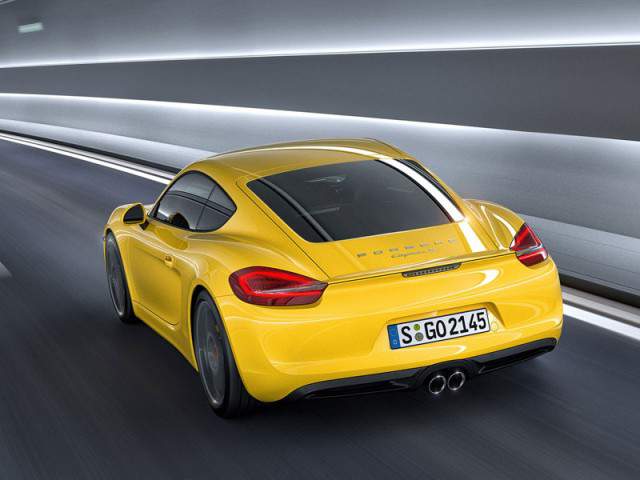
Especially the tail area was designed differently and presents greater attack, although Porsche fans have certainly used to the new form.
To start, customers can choose between the Cayman and Cayman S. The Cayman is powered by a 2.7-liter 6-cylinder boxer engine with a power of 275 hp (202 kW) and accelerates in 5.4 seconds from 0 to 100 km / h, top speed is 266 km / h.
Even more fun features then the Porsche Cayman S, which is powered by a 3.4-liter boxer engine and its power at 325 bhp (239 kW) and the little athlete in 4.7 seconds from zero to 100 km / h conveyed .

The top speed is 283 km / h Both motors can also be combined with the automatic PDK transmission. Consumption is on the Cayman 7.7 to 8.2 liters and the Cayman S from 8.0 to 8.8 liters per 100 kilometers, depending on what Gearbox has been chosen.
Upgraded Porsche Cayman also has regard to the facilities: the first time for the sports coupe is also an adaptive cruise control, a keyless entry system and a specially developed Burmester - sound system available.
Available is the new Porsche Cayman from March 2013. In Germany, it is available from 51,385 euros.


[ Read More.. ]
The 2013 new Porsche Cayman was unveiled at the Los Angeles Auto Show in 2012 and now shows more original than its predecessor. It is lighter, flatter and more agile and should thus still offer greater driving pleasure.
Depending on the model, the new Cayman is by up to 30 kilograms, has become easier and more efficient by up to 15 percent on the road. Visually, the new Cayman is different from the Porsche Boxster now stronger than before.
Especially the tail area was designed differently and presents greater attack, although Porsche fans have certainly used to the new form.
To start, customers can choose between the Cayman and Cayman S. The Cayman is powered by a 2.7-liter 6-cylinder boxer engine with a power of 275 hp (202 kW) and accelerates in 5.4 seconds from 0 to 100 km / h, top speed is 266 km / h.
Even more fun features then the Porsche Cayman S, which is powered by a 3.4-liter boxer engine and its power at 325 bhp (239 kW) and the little athlete in 4.7 seconds from zero to 100 km / h conveyed .
The top speed is 283 km / h Both motors can also be combined with the automatic PDK transmission. Consumption is on the Cayman 7.7 to 8.2 liters and the Cayman S from 8.0 to 8.8 liters per 100 kilometers, depending on what Gearbox has been chosen.
Upgraded Porsche Cayman also has regard to the facilities: the first time for the sports coupe is also an adaptive cruise control, a keyless entry system and a specially developed Burmester - sound system available.
Available is the new Porsche Cayman from March 2013. In Germany, it is available from 51,385 euros.
Monday, November 25, 2013
2012 Porsche Panamera Price of 67 000
 The 2012 Porsche Panamera is one of the latest version of 2012 Porsche. A 2012 Porsche Panamera is a 4-door, 4-passenger sports sedan, available in 7 trims, ranging from the 2012 Porsche Panamera Base to the 2012 Porsche Panamera S Hybrid. The 2012 Porsche Panamera is available at price of $75,200 - $173,200 And has Invoice price of $67,500 - $155,700.
 Upon introduction, the 2012 Porsche Panamera Base is equipped with a standard 3.6-liter, V6, 300-horsepower engine that achieves 18-mpg in the city and 27-mpg on the highway. A 7-speed manual transmission with overdrive is standard.
  The 2012 Porsche Panamera S Hybrid is equipped with a standard 3.0-liter, V6, 333-horsepower, supercharged, hybrid engine that achieves 22-mpg in the city and 30-mpg on the highway. A 8-speed automatic transmission with overdrive is standard. The 2012 Porsche Panamera S Hybrid is powered by a 3.0L supercharged V6 engine capable of making 333-hp coupled with a 47-hp electric-motor. The electric motor is powered by nickel metal hydride battery that stores energy from braking and other driving situations allowing Panamera to travel on pure electricity for one mile at speeds of just over 50 mph. From ultra luxury to ultra performance, the 2012 Porsche Panamera is the "everything to everybody" sedan.
Sunday, November 24, 2013
H R Porsche Panamera 4 V6
With the Panamera, Porsche is once again setting standards in the luxury car class. - Also in the chassis. - A challenge that was from the H & R engineers gladly accepted. The result of the complex development work is a set of springs, of the four-door and four-wheel V6 brings you closer with conventional suspension, approximately 35 millimeters on the tarmac.

The basic characteristics of the elegant and classic lines are accented with the Dynamis ierungspaket without diluting the overall concept of designerische luxury sedan. Even the ride spring kit could be made dynamic by several shades with the H & R. - Of course without the comforts of upper-class athlete to significantly schmälern. H & R Porsche Panamera four-wheel-drive V6: Sports car dynamics in the luxury-class sedan. In brief, the air-sprung versions using the H & R ETS is lowered.
Another highlight can be set with high strength aluminum alloy produced H & R TRAK + wheel spacers. The small gap between the tire shoulder and edge of the wing can be so visually perfected, which results in a more powerful appearance of the effect of the sedan.
The H & R program - available for over 1,350 different types of vehicles - is available in good bookstores and along with the usual H & R quality, always has an ABE or TÜV parts certificate.
[ Read More.. ]
The basic characteristics of the elegant and classic lines are accented with the Dynamis ierungspaket without diluting the overall concept of designerische luxury sedan. Even the ride spring kit could be made dynamic by several shades with the H & R. - Of course without the comforts of upper-class athlete to significantly schmälern. H & R Porsche Panamera four-wheel-drive V6: Sports car dynamics in the luxury-class sedan. In brief, the air-sprung versions using the H & R ETS is lowered.
Another highlight can be set with high strength aluminum alloy produced H & R TRAK + wheel spacers. The small gap between the tire shoulder and edge of the wing can be so visually perfected, which results in a more powerful appearance of the effect of the sedan.
The H & R program - available for over 1,350 different types of vehicles - is available in good bookstores and along with the usual H & R quality, always has an ABE or TÜV parts certificate.
Thursday, November 21, 2013
Porsche Panamera Sport Turismo at 2012 Paris Motor show
Porsche shows in Paris with the concept car Porche Panamera Sport Turismo as a plug-in hybrid combination of the brand might look in the future.

With the Porsche Panamera Sport Turismo is a preview of a possible Porsche family sports car of the future, to be driven via a plug-in hybrid.
At a length of 495 cm to the sporty shooting brake provide plenty of space for the family, but it shine with typical Porsche driving. The whole is then seasoned with a dash of high-tech and we can hope that the Panamera Sport Turismo is something like that find their way into the series.
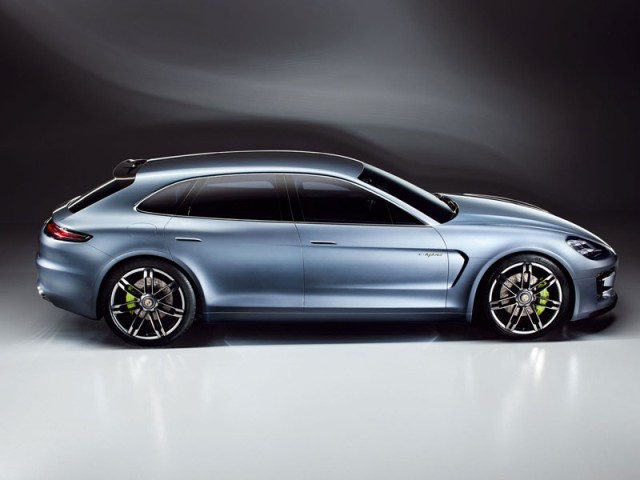
In designing the Panamera Sport Turismo shows already look like a revised version of the current Panamera could. The front end got bigger headlights, but has the tail on similar LED taillights like the Porsche 911 Carrera.
The mix gives the large combined high dynamics and lets him act fast even when standing still. The drive is intended to serve a plug-in hybrid, while the 3.0-liter supercharged V6 engine that has an output of 333 hp has (245 kW), with a combined 95 hp (70 kW) electric motor, resulting in a system performance of 416 hp (306 kW) results.
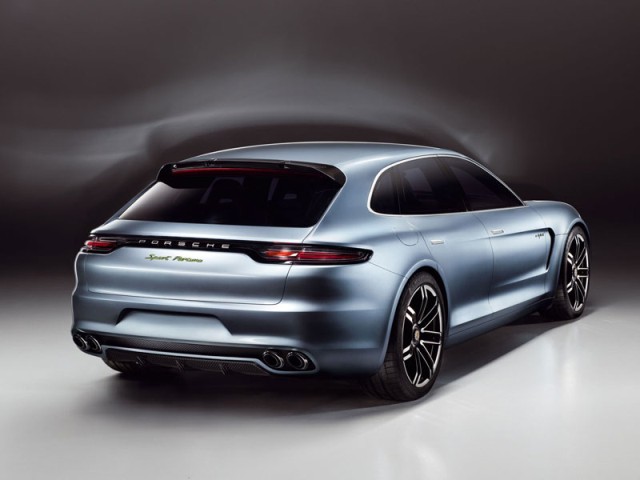
The acceleration from 0 to 100 km / h should be completed in less than 6 seconds, the pure electric range should be around 30 kilometers. In electric mode, you should also can drive up to 130 km / h, only then will activate the gasoline engine to do so.
On average, the consumption of fast combos are as low as 3.5 liters, which would to a CO2 emission of 82 g correspond / km. The batteries should be in about 2.5 hours charged from a standard wall outlet again.
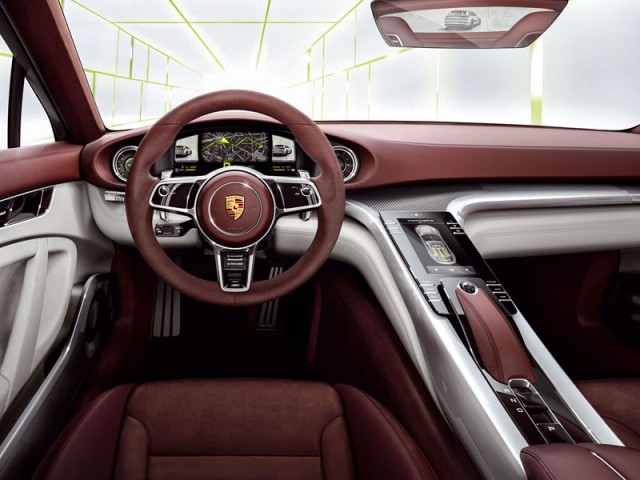
The interior of the Porsche Panamera Sport Turismo looks somewhat futuristic, but has been adapted to the alternative drive technology. For instance the concept car on a large monitor instead of the more centrally positioned tachometer, to brief them on navigation, range and energy flow. Further information on the energy distribution is also found in the center console.
Although the Panamera Sport Turismo is only presented as advance study, he shows quite clearly the direction in which it can go in the future with Porsche.
[ Read More.. ]
With the Porsche Panamera Sport Turismo is a preview of a possible Porsche family sports car of the future, to be driven via a plug-in hybrid.
At a length of 495 cm to the sporty shooting brake provide plenty of space for the family, but it shine with typical Porsche driving. The whole is then seasoned with a dash of high-tech and we can hope that the Panamera Sport Turismo is something like that find their way into the series.
In designing the Panamera Sport Turismo shows already look like a revised version of the current Panamera could. The front end got bigger headlights, but has the tail on similar LED taillights like the Porsche 911 Carrera.
The mix gives the large combined high dynamics and lets him act fast even when standing still. The drive is intended to serve a plug-in hybrid, while the 3.0-liter supercharged V6 engine that has an output of 333 hp has (245 kW), with a combined 95 hp (70 kW) electric motor, resulting in a system performance of 416 hp (306 kW) results.
The acceleration from 0 to 100 km / h should be completed in less than 6 seconds, the pure electric range should be around 30 kilometers. In electric mode, you should also can drive up to 130 km / h, only then will activate the gasoline engine to do so.
On average, the consumption of fast combos are as low as 3.5 liters, which would to a CO2 emission of 82 g correspond / km. The batteries should be in about 2.5 hours charged from a standard wall outlet again.
The interior of the Porsche Panamera Sport Turismo looks somewhat futuristic, but has been adapted to the alternative drive technology. For instance the concept car on a large monitor instead of the more centrally positioned tachometer, to brief them on navigation, range and energy flow. Further information on the energy distribution is also found in the center console.
Although the Panamera Sport Turismo is only presented as advance study, he shows quite clearly the direction in which it can go in the future with Porsche.
Saturday, November 16, 2013
2011 Porsche Cayman

Specifications prices Modifications and Image 2011 Porsche Cayman
There is no doubt that the Porsche 911 has been long ordained by Stuttgart as the family flagship sports car. However, when the Cayman made its appearance in 2006, more than a few folks in the industry raised their eyebrows and thought the buttery-smooth handling character of the mid-engine Porsche could outrun its older brother, especially given equal power. To keep the 911 on top, Porsche intentionally kept the Cayman’s engine output below that of the Porsche icon. But now with the introduction of the lightweight 2012 Cayman R, could the little brother encroach on the 911’s territory?

INTERIOR
At the interior side, Porsche Cayman base and S has equipped with air conditioning system, two-sport seats, electric windows, windscreen washer system, electrically exterior mirror and interior lighting. While for the top trim level, Porsche Cayman R, added with cruise control, windshield and an adjustable sport steering wheel design. For the entertainment system, the Cayman has been featured with Bose surround sound system, AM/FM CD player and MP3 compatible also universal audio interface at the Cayman R. At the safety terms, Porsche Cayman has equipped with airbags, seat belts, braking system and many high technology of safety system.

ENGINE
The base Cayman has a 2.9-liter six-cylinder engine that produces 265 horsepower at 7,200 rpm and 221 pound-feet of torque. The more powerful Cayman S features a 3.4-liter six-cylinder engine that makes 320 horsepower at 7,200 rpm and 273 pound-feet of torque. With a maximum speed of 175 mph, the Cayman R is the most powerful and fastest model. It has a 3.4-liter six-cylinder engine that produces 330 hp at 7,400 rpm and 273 pound feet torque.
Porsche claims that the base Cayman has a top speed of 165 mph and can accelerate from 0 to 60 mph in 5.5 seconds. The Cayman S trumps the base with a top speed of 172 mph and a 0 to 60 acceleration time of just 4.9 seconds.
All models have a standard six-speed manual transmission. The Porsche Doppelkupplung (PDK) transmission is optional on all models, but isn’t cheap. The PDK costs $3,420.
According to the EPA, the base Cayman gets 19/27 mpg city/highway with the manual transmission and 20/29 city/highway with the automatic. The Cayman S nets 19/26 mpg city/highway with the six-speed manual transmission and 20/29 city/highway with the automatic. There is no fuel economy data available for the Cayman R.
Porsche claims that the base Cayman has a top speed of 165 mph and can accelerate from 0 to 60 mph in 5.5 seconds. The Cayman S trumps the base with a top speed of 172 mph and a 0 to 60 acceleration time of just 4.9 seconds.
All models have a standard six-speed manual transmission. The Porsche Doppelkupplung (PDK) transmission is optional on all models, but isn’t cheap. The PDK costs $3,420.
According to the EPA, the base Cayman gets 19/27 mpg city/highway with the manual transmission and 20/29 city/highway with the automatic. The Cayman S nets 19/26 mpg city/highway with the six-speed manual transmission and 20/29 city/highway with the automatic. There is no fuel economy data available for the Cayman R.

EXTERIOR
To emphasize the seriousness of the Cayman R as a sports car, it comes standard without air conditioning or stereo system. Aluminum doors, carbon-fiber interior door panels and seats also contribute to the car’s svelte curb weight of just under 3000 lbs. That’s 121 lbs lighter than the Cayman S. Porsche engineers lowered the R’s ride height by 0.8 inches, and added custom anti-roll bar and stiffer springs with a limited slip differential for reduced roll angle and improved traction through the corners on the road or track.
Technical specs aside, the Cayman R road manners are impressive—at least to the extent we can sample the car’s limits in rain soaked and at times heavy hail downpour roads in Malloraca. While the R’s ultimate performance limit was not fully explored, its predictable wet-handling character perhaps was more telling about the car’s drivability. Either with Porsche Stability Management (PSM) system on or off, the Cayman R showed good stability at all speeds. And any time traction was reduced, the behavior was progressive allowing you plenty of time to react with steering input or throttle modulation.
Technical specs aside, the Cayman R road manners are impressive—at least to the extent we can sample the car’s limits in rain soaked and at times heavy hail downpour roads in Malloraca. While the R’s ultimate performance limit was not fully explored, its predictable wet-handling character perhaps was more telling about the car’s drivability. Either with Porsche Stability Management (PSM) system on or off, the Cayman R showed good stability at all speeds. And any time traction was reduced, the behavior was progressive allowing you plenty of time to react with steering input or throttle modulation.
reference:inopowers.net,www.roadandtrack.com,www.caranddriver.com

Friday, November 15, 2013
Porsche planning private track near Shanghai

The German based automaker Porsche is planning to build its own private track, near Shanghai, China, in order for its customers to push the limits of their loved cars.
According to the guys over at chinacartimes.com, the manufacturer might build a track near Shanghai, because Porsche drivers can’t push the limits in their vehicles due to the imposed top speed of 120 km/h for passenger cars. So with that limit being easily reached by Porsche, the automaker is planning to open a private race course, which will actually be similar to the company’s own testing track in Leipzig, an F1 track that didn’t host an F1 race ever since 2002, currently serving as a Porsche internal testing track.
Porsche will bring the “German feel” to China by opening a new track near Shanghai, and since the Asian country has become the company’s second biggest market, after the United States, the automaker is “giving back” something to the community. The best sold Porsche model in China is currently the Cayenne SUV, but this is closely followed by the Panamera. Sales of two-seater sports cars are quite low, but even so, the manufacturer managed to sell 24.340 new cars in China in 2011 alone.
Subscribe to:
Posts (Atom)